60 Years Old Does Not Mean They Should Die: The Struggle of Noor Begum to Reach Treatment
About Article
60 Years Old Does Not Mean They Should Die: The Struggle of Noor Begum to Reach Treatment
RYAN Newsfeed | Humanitarian Affairs & Refugee Healthcare
7 September 2026
Rohingya Refugee Camp, Cox’s Bazar, Bangladesh
A patient’s struggle for treatment raises a wider question about how elderly and highly dependent Rohingya refugees are supported in the camps.
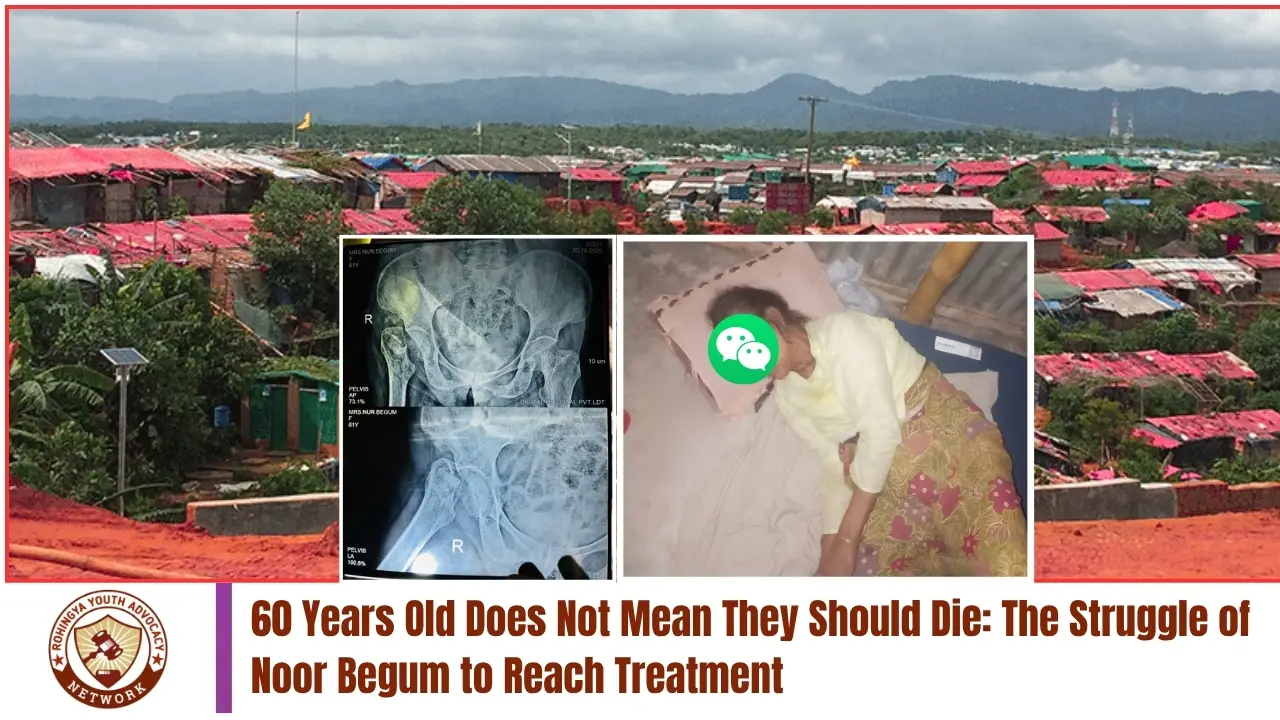
For more than a year, Noor Begum, a Rohingya woman over 60 living in Camp 2W, Cox’s Bazar, has been waiting for appropriate medical and rehabilitation support.
Her situation is not simply about being elderly. Following a serious hip fracture in 2025 and several strokes, including a third stroke, Noor Begum has become highly dependent on others for movement and many basic daily activities. She requires assistance to move, use the toilet, take medicines and manage everyday needs.
For a person in this condition, reaching a health facility is itself a major challenge.
Yet her family says that despite repeatedly seeking assistance, they have spent approximately one year trying to find a pathway that could provide her with appropriate assessment, rehabilitation, disability support and treatment.
The experience raises a difficult question:
When an elderly refugee is unable to reach services independently, should the responsibility for reaching the patient simply end with a referral?
A Life Becoming Increasingly Dependent
Noor Begum's mobility changed dramatically after her hip fracture in 2025.
Before her condition deteriorated, she could manage more of her daily life independently. Today, she depends heavily on family members for basic movement and personal care.
Her only son is now one of the main people supporting her. He also has his own family and responsibilities, making continuous caregiving difficult.
The family says they have not been asking for special treatment.
They have been asking for something more basic: an assessment of her condition and a realistic pathway to care.
If a particular service cannot be provided, they want to understand why. If a patient is not eligible for a particular programme, they want a clear explanation. If treatment must be obtained elsewhere, they need meaningful referral and guidance that takes the patient's physical limitations into account.
For Noor Begum, simply being told where to go is not always enough.
She cannot travel like a healthy person.
When a Referral Is Not the Same as Access
On 7 October 2025, the family personally approached the GK Primary Health Care in Camp 2W, B Block, seeking assistance for Noor Begum.
According to the family's account, they were informed that the necessary care for an elderly patient with her needs could not be provided because of limitations in available resources, and the family was referred to MSF.
No ambulance or other transportation assistance was provided.
The family therefore arranged transportation themselves and took Noor Begum to an MSF facility by CNG, helping her throughout the journey because of her severe mobility limitations.
According to the family's recollection of the consultation, they were told that because Noor Begum was over 60 and her condition was longstanding, there were limited possibilities for curing the condition. They received advice regarding her care and medication and were told, in substance, that she could remain at home and receive the necessary medicines.
This account represents the family's recollection of their experience and should not be understood as a statement of an organization-wide policy.
But the experience left the family with a difficult reality: Noor Begum was still at home, still highly dependent, and still without a clear pathway toward the rehabilitation and treatment they were seeking.
A Home Visit That Has Not Yet Happened
The family also approached Handicap International seeking disability-related assistance.
The family understood that the organization had limited capacity for physiotherapy and disability-related services. They were not expecting unlimited treatment or resources.
They were seeking an assessment and hoping that, if appropriate, Noor Begum could receive whatever physiotherapy, rehabilitation, assistive support or referral services were available.
The family says they were informed that there would be follow-up and a home visit.
However, nearly one month after the initial communication, Noor Begum had still not received the expected home visit at the time of saying.
For a mobile patient, waiting for a referral or appointment may be difficult.
For a patient who cannot move independently, the situation is fundamentally different.
The question is not only whether a service exists. It is whether the patient can physically reach it.
Outside the Camp, the Answer Appeared Different
According to the family, the camp-based health services they approached could not provide the treatment pathway Noor Begum needed.
The family then sought an assessment outside the camps.
At Evercare Hospital Chattogram, the family says they received a substantially different understanding of Noor Begum's treatment possibilities.
According to the information communicated to the family, they were told that her condition could be treated and that treatment could potentially improve her situation. The family says they were also given a treatment budget of nearly BDT 700,000 (seven lakh taka).
Evercare Hospital Chattogram publicly describes orthopaedic services that include treatment for fractures, hip and knee problems, trauma and conditions affecting older people, while its Physical Medicine and Rehabilitation department lists rehabilitation services including stroke rehabilitation, complex orthopaedic rehabilitation and geriatric rehabilitation.
Evercare Hospital Chattogram — Orthopaedics
Evercare Hospital Chattogram — Physical Medicine & Rehabilitation
However, Evercare's public information does not independently confirm Noor Begum's individual assessment or the family's reported treatment estimate. The nearly BDT 700,000 figure is based on the information provided to the family and has not been independently verified by RYAN.
For Noor Begum, the problem is now painfully clear.
Treatment may exist, but treatment she cannot afford is still treatment she cannot reach.
Seven Lakh Taka Between a Patient and Treatment
The family says Noor Begum remains at home while they try to find a way to raise the estimated BDT 700,000 needed for treatment in Chattogram.
For a refugee family living with limited financial resources, seven lakh taka is an enormous amount.
It is not simply a medical bill.
It represents transportation, accommodation, food, caregiving, medical investigations, possible follow-up appointments and the cost of maintaining a dependent elderly patient during treatment.
The family has not yet been able to secure the full amount.
As a result, Noor Begum remains waiting.
Waiting at home.
Waiting for an assessment.
Waiting for rehabilitation or appropriate support.
And now, waiting for enough money to travel to Chattogram for the treatment that her family says they were told may be possible.
The Cost of Being Unable to Walk
Noor Begum's case demonstrates a gap that can easily remain invisible in humanitarian healthcare systems.
A health facility may technically be available.
A referral may technically be provided.
A specialist may technically exist outside the camp.
But none of these necessarily means that an elderly person with severe mobility limitations has meaningful access to healthcare.
For someone who cannot walk independently, reaching a health facility can require another person, transportation, physical lifting and additional money.
For someone whose family is already struggling to provide daily care, every additional journey creates another burden.
For someone who needs rehabilitation, a single consultation may not be enough.
And for someone who cannot afford treatment outside the camp, a referral alone cannot guarantee access.
What Happens to Elderly Refugees Who Cannot Keep Up?
Noor Begum's case also raises a broader humanitarian question.
As Rohingya displacement continues, the population is ageing. Some refugees now live with long-term disabilities, reduced mobility, frailty and complex care needs.
Humanitarian health services must therefore consider not only emergency care, but also what happens to people who become increasingly dependent on others.
A 2026 study of healthcare access among Rohingya refugees in Bangladesh reported significant barriers to accessing appropriate care, including difficulties travelling long distances and limited availability of outreach services. Research on ageing and disability among Rohingya refugees has likewise highlighted the growing importance of support for older and more vulnerable people.
The World Health Organization has also warned of the consequences of funding shortages for refugee health services in Bangladesh, including potential impacts on referral services, rehabilitation and physiotherapy for persons with disabilities, and community health services.
World Health Organization — Health response for Rohingya refugees in Bangladesh
These challenges make cases like Noor Begum's increasingly important.
Because an elderly person should not become invisible simply because they cannot travel to the service themselves.
Care Must Reach the Patient
Noor Begum's experience is not presented as evidence that every health organization is failing elderly refugees.
Nor does it suggest that every patient can or should receive treatment that may not be medically appropriate.
The central issue is simpler.
An elderly patient with severe mobility limitations needs an assessment that takes her circumstances into account.
If treatment is unavailable, the family deserves a clear explanation.
If rehabilitation is unavailable, there should be an appropriate referral.
If a home visit is necessary, it should happen within a reasonable timeframe.
If treatment is available outside the camp but unaffordable, humanitarian actors should consider whether there are referral, financial-support or protection mechanisms that can help vulnerable patients access it.
And if a patient cannot physically reach a service, the system must ask whether the service can reach the patient.
Noor Begum Is Still Waiting
Today, Noor Begum remains in Camp 2W.
She is over 60.
She has severe mobility limitations.
She depends on family members for basic daily activities.
Her family has spent months trying to identify appropriate care.
They have travelled to health facilities themselves.
They have sought disability and rehabilitation support.
They have sought assessment outside the camps.
They have been given an estimated treatment cost of nearly BDT 700,000.
But they have not yet been able to raise the amount required to pursue that treatment in Chattogram.
So Noor Begum continues to wait.
Her case leaves one question that should not be ignored:
If a person is too old, too disabled, too dependent and too poor to reach the healthcare system, who is responsible for making sure that the healthcare system reaches them?
Being 60 or older should never mean that a person's remaining years are treated as less worthy of care.
Noor Begum does not need pity. She needs to be seen, assessed and given a fair chance to receive appropriate care.
RYAN's Position
RYAN believes that elderly and highly dependent refugees should not be excluded from meaningful healthcare simply because of age, disability, mobility limitations or financial hardship.
Healthcare access should be measured not only by whether a facility exists, but by whether a vulnerable patient can realistically reach and benefit from that service.
Noor Begum's case deserves attention not because she is one individual, but because her experience may reflect challenges faced by other elderly and highly dependent refugees whose needs remain difficult to see.
Editorial Note
This publication is based on the reported experience of Noor Begum and her family. References to consultations, referrals and interactions with health or humanitarian organizations describe the family's recollection and should not be interpreted as statements of organizational policy or as findings against any organization.
The reported treatment estimate of nearly BDT 700,000 at Evercare Hospital Chattogram was communicated to RYAN by the family and has not been independently verified. RYAN does not claim that the amount represents a final treatment cost or guarantee of outcome.
The purpose of this publication is to highlight barriers faced by an elderly Rohingya patient with severe mobility limitations and to encourage greater attention to accessible, dignified and appropriate healthcare for older and highly dependent refugees.
References and Further Reading
Date
2026-09-07
Location
Rohingya Refugee Camp, Ukhiya, Cox's Bazar
Quick Summary
Noor Begum, a Rohingya woman over 60 in Camp 2W, remains waiting for treatment after becoming severely mobility-impaired...
Related News
2026-11-12
UN Special Rapporteur to Visit Rohingya Refugee Camps as Myanmar Military Regime Declines to Host Her
2026-11-12
Rohingya National Education Board to Hold Examinations for 18,500 Students from 100 Community-Based School Across the Refugee Camp
2026-11-10