Standing for Human Rights: The Story of a Rohingya Human Rights Defender
About Article
A Brief Introduction
Human rights advocacy is often spoken about in terms of principles, laws, and international commitments. But for people living through displacement, insecurity, and exclusion, human rights are much more personal. They are connected to safety, dignity, freedom, access to healthcare, education, justice, and the simple ability to live without fear.
For many Rohingya human rights defenders, speaking about these rights is not merely a professional responsibility. It is a commitment shaped by lived experience.
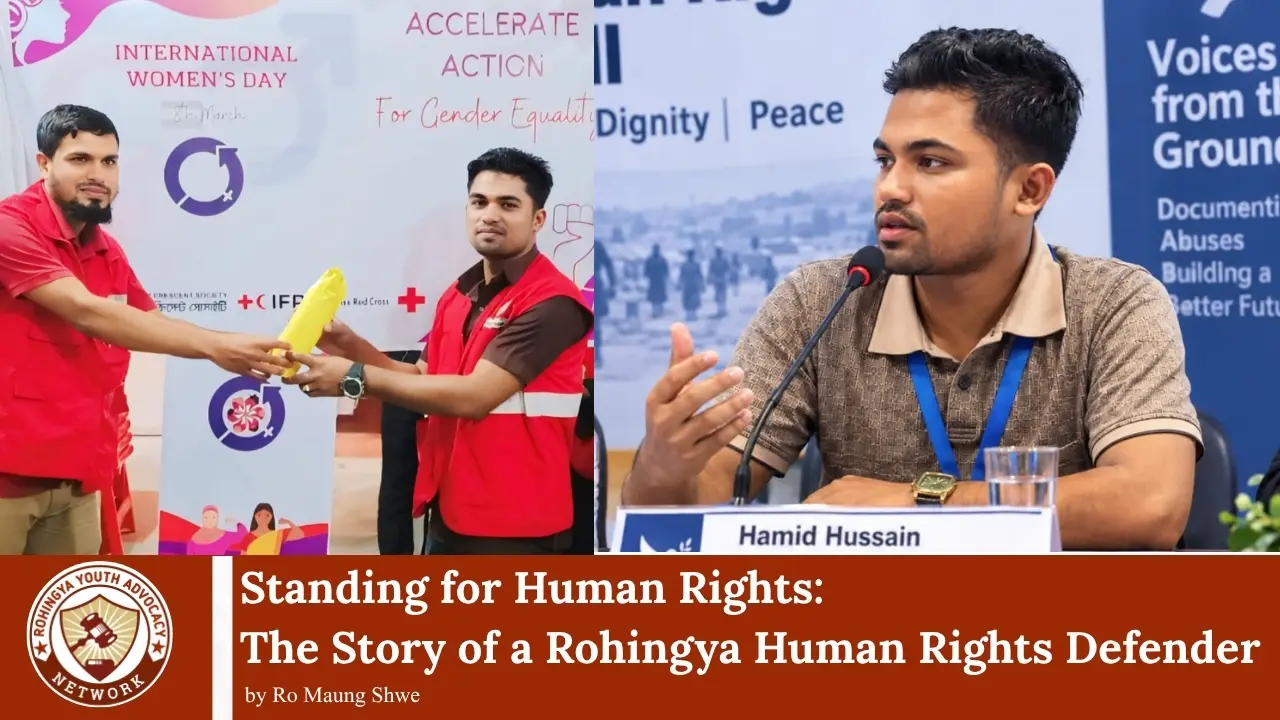
Hamid Hussain, a Rohingya human rights defender from Myanmar, is one of those individuals whose journey has been shaped by displacement, community service, human rights awareness, and a continued commitment to peaceful advocacy.
His story reflects not only the challenges faced by Rohingya communities, but also the determination of individuals who continue to speak, document, listen, and support others despite difficult circumstances.
From Ngan Chaung to Displacement
Hamid Hussain was born and raised in Ngan Chaung Village, Maungdaw Township, Rakhine State, Myanmar. Like many Rohingya children, he grew up in an environment where access to basic services and opportunities was limited.
From an early age, Hussain developed an interest in helping people. One of his childhood aspirations was to become a doctor. His interest was influenced by the difficulties he witnessed around him, particularly the limited access to healthcare and the challenges faced by people in rural communities.
The circumstances surrounding the Rohingya community changed dramatically in 2017. Violence and persecution forced hundreds of thousands of Rohingya to flee Myanmar. Hussain was among those who were displaced and eventually sought safety in Bangladesh.
Displacement changed the direction of his life, but it did not end his desire to serve his community.
From Humanitarian Service to Human Rights Advocacy
After arriving in Bangladesh, Hussain became involved in community and humanitarian activities. His work included health awareness, household visits, community engagement, referrals, and helping people understand and access available services.
Through these experiences, he began to understand that many of the problems facing refugees were not only humanitarian concerns. They were also deeply connected to human rights.
People needed more than emergency assistance. They needed to be heard.
They needed protection, dignity, access to justice, education, healthcare, and opportunities to participate in decisions affecting their lives.
This gradually encouraged Hussain to become more involved in human rights awareness, documentation, and advocacy.
His work has focused on listening to community members, understanding their concerns, documenting issues, and raising awareness about rights and protection.
For him, advocacy is not about speaking over vulnerable people. It is about creating space for them to be heard.
When Advocacy Comes at a Personal Cost
Human rights advocacy can carry significant risks, particularly in environments where people who document abuses or speak openly about community concerns may become targets of intimidation.
Hussain says that his own advocacy journey has come with serious personal risks.
According to his account, he experienced threats, intimidation, and other forms of pressure because of his human rights activities. He also describes an incident in 2023 in which he was allegedly kidnapped and detained for approximately two days.
Hussain says that during the incident he was severely mistreated and warned to stop his human rights work.
For a person already living through displacement and insecurity, such an experience could have been enough to force silence.
But Hussain continued.
The 2024 Shooting
The most serious incident described in Hussain's account occurred on 29 May 2024, when he says he was shot and seriously injured.
Following the incident, he required medical treatment and spent time recovering in hospital.
The experience left a lasting impact on him. Yet rather than abandoning his commitment to human rights, Hussain says that the incident strengthened his understanding of the importance of peaceful advocacy and community protection.
His story illustrates a difficult reality faced by some Rohingya defenders: advocating for human rights can itself become a source of danger.
Human rights defenders working in and around the Rohingya refugee camps have faced threats, attacks, abductions, and other forms of pressure. International human rights organizations have documented the broader protection challenges confronting Rohingya defenders in Bangladesh.
The Courage to Continue
Despite the experiences he describes, Hussain has continued to believe that violence is not the answer.
His approach to advocacy is centered on peaceful engagement, documentation, awareness, and dialogue.
He believes that communities become stronger when people are informed about their rights and when vulnerable individuals are given the confidence and opportunity to speak for themselves.
This commitment has also shaped the way he understands leadership.
For Hussain, being a human rights defender does not necessarily mean being the loudest person in the room. Sometimes it means listening carefully to a survivor, helping someone understand where to seek assistance, documenting a story that might otherwise remain unheard, or standing beside someone who feels alone.
Listening Before Speaking
One of the most important elements of Hussain's experience is the importance he places on listening.
Humanitarian and human rights work can sometimes become focused on statistics, reports, projects, and institutional language. But behind every statistic is a person with a story.
A displaced family has a story.
A survivor has a story.
A person denied healthcare has a story.
A young person denied education has a story.
Hussain believes that effective advocacy begins by understanding these individual experiences.
Listening allows advocates to identify problems more accurately, communicate community concerns more responsibly, and ensure that the voices of affected people remain at the center of advocacy.
A Commitment to Peaceful Advocacy
Hussain's experiences have also reinforced his belief in peaceful and responsible human rights advocacy.
He maintains that documenting violations, raising awareness, supporting vulnerable people, and advocating for justice can be pursued without promoting violence.
His journey from a young person who dreamed of becoming a doctor, to a displaced Rohingya, to a community worker and human rights defender, reflects how personal experiences can shape a person's understanding of justice and responsibility.
His story is ultimately not only about the incidents he says he survived. It is also about what he chose to do afterward.
He chose to continue serving.
He chose to continue listening.
He chose to continue advocating.
And he chose to believe that dignity and justice remain worth defending.
Looking Toward the Future
As Hussain continues his human rights journey, he is also looking for opportunities to strengthen his engagement with youth-led and community-based initiatives.
He has expressed an interest in joining and contributing to the work of the Rohingya Youth Advocacy Network (RYAN), particularly in areas connected to human rights awareness, community advocacy, youth engagement, and the protection of vulnerable people.
His interest in working with RYAN reflects his desire to continue contributing to a wider community effort rather than presenting his work as an individual mission.
At the time of publication, Hussain should not be understood as a representative, staff member, or official member of RYAN. His connection to the organization is currently expressed through his interest in joining and contributing to its work.
Beyond One Individual
The story of Hamid Hussain is ultimately larger than one individual.
It is a story about what happens when displacement does not destroy a person's desire to serve others.
It is a story about how humanitarian experiences can lead people toward human rights advocacy.
It is also a reminder that those who defend the rights of others may themselves need protection, recognition, and solidarity.
The future of Rohingya advocacy will depend not only on international institutions and established organizations, but also on community members who are willing to listen, learn, document, and speak responsibly.
Hussain's journey is one example of that commitment.
His story reminds us that human rights are not abstract ideas. They are lived realities—and protecting them requires courage, responsibility, and the willingness to stand with people whose voices might otherwise remain unheard.
Author's Note
This profile draws on the experiences, reflections, and personal account of Hamid Hussain, a Rohingya human rights defender. At the time of publication, Hussain has expressed his interest in joining and contributing to the work of the Rohingya Youth Advocacy Network (RYAN). The experiences and incidents described in this profile are presented as part of his personal account unless otherwise independently attributed or verified.
Date
2026-09-13
Published By
By Ro Maung Shwe, RYAN Youth Voice
Quick Summary
A Rohingya human rights defender’s journey of courage, advocacy, and resilience.
Related Articles
2026-11-18
Rohingya Community Awaits Historic ICJ Judgment: A Defining Moment for Justice and Accountability
2026-10-28
The Courageous Journey of Young Rohingya Activist Shakil Akter: From Forced Displacement and Family Persecution to Defending Human Rights
2026-09-09